Best Fiverr Alternatives for Logo Design in 2026
 Jul 25,2026
Most founders don’t start looking for a Fiverr alternative out of curiosity. They start looking after a mixed experience: a logo that looks close enough to a stock template, three rounds of revisions that went nowhere, a seller who disappeared mid-project, or a final file that turned out to be unusable outside a small square format. If that’s why you’re here, the good news is you have more options than another marketplace search, and not all of them repeat the same problem in a different color scheme.
Is Fiverr Worth It for Logo Design?
For a five-minute placeholder on a near-zero budget, Fiverr can work. For a logo you’ll put on a website, a product, packaging, or a pitch deck in front of investors, it’s inconsistent. Quality depends entirely on which seller you land on, there’s minimal vetting on the platform itself, and most gigs deliver a flat file with no strategic thinking behind the shapes, the color choices, or how the mark will actually hold up at different sizes. You’re paying for a graphic, not for branding. That distinction is small on day one and expensive a year later, once the logo needs to work across a real business.
Why the Fiverr Model Struggles for Branding Specifically
The issue isn’t any individual seller. It’s structural. Fiverr optimizes for speed and low prices, which pushes sellers toward templates and fast turnarounds rather than a discovery process. There’s no brief review, no questions about your positioning or your competitors, and often no explanation of why a particular direction was chosen. Revisions are capped low, so disagreements get resolved by compromise rather than by getting the mark right. And because reviews are the main quality signal, sellers are incentivized to avoid pushback, even when pushback is exactly what a founder needs early on.
None of this makes Fiverr useless. It makes it a mismatch for anything beyond a quick, disposable asset, especially once you’re building an actual brand identity rather than sourcing a single graphic.
The Three Types of Fiverr Alternatives
Not all alternatives solve the same problem. Before picking one, it helps to know which category you’re actually choosing between, because comparison lists tend to blend all three together.
DIY Logo Makers
Tools like Looka, Turbologo, Canva, or Fiverr’s own AI Logo Maker generate a logo from a template in minutes, sometimes for free. They’re fast, cheap, and require zero back and forth. The tradeoff shows up the moment you search your own industry online: the same shapes, the same rounded sans-serif fonts, and the same three icon styles show up across thousands of other small businesses using the same generator. Fine for validating an idea before you spend real money. Risky as the permanent face of a brand you want people to actually remember.
Other Freelance Marketplaces
Upwork, 99designs, Dribbble, Toptal, Guru, PeoplePerHour. These fix Fiverr’s discovery problem in different ways: 99designs runs contests so you see finished concepts before paying, Dribbble and Toptal add a portfolio-first filter, Upwork adds structured proposals and hourly tracking. All of that helps you find a better individual freelancer. None of it changes the underlying model. You’re still sourcing a stranger, still writing the brief yourself, still managing scope and revisions, and still likely to end up with a logo file and nothing else. Good for a well-defined one-off task if you already know exactly what you want. Not built to think through a brand for you.
Fixed-Scope Branding Agencies
This is the category most “Fiverr alternatives” listicles skip entirely, because it doesn’t fit the marketplace format they’re built to compare. Instead of browsing seller profiles and hoping for the best, you get a fixed price, a defined process, and a designer who already knows what a real identity needs beyond a logo: a color system, typography choices, and usage guidelines that keep everything consistent as the business grows. Brandframer works this way, with three packages starting at $280 and a first concept delivered within 48 hours, without the back-and-forth of a marketplace negotiation.
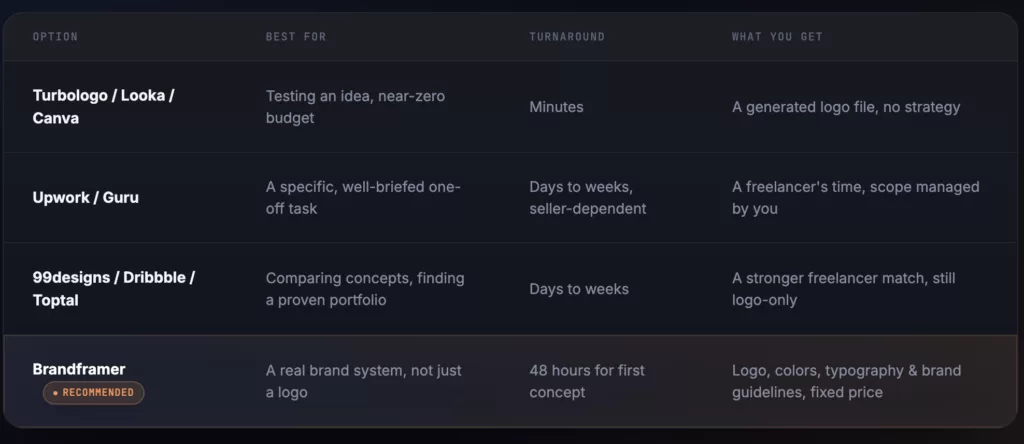
Fiverr Alternatives at a Glance
Four ways to get a logo done, and what you actually walk away with.
What Separates a Good Alternative From Fiverr
Four things matter more than which platform’s logo you’re looking at.
Who’s actually designing it. A named designer with a documented process and reviewable past work beats an anonymous seller ranked mainly by star count you can’t independently verify.
What you get, not just a logo file. A single PNG or vector solves today’s problem and quietly creates tomorrow’s, the moment you need a business card, a website header, packaging, or a social kit in a shade of blue nobody wrote down anywhere.
Clear ownership from the start. You should know exactly what you’re allowed to do with the final files before you pay, not after a dispute over commercial usage rights.
A defined, guaranteed timeline. “A few days, usually” and “48 hours, guaranteed” are not the same promise, and only one of them lets you plan a launch date around it.
Which Alternative Fits Your Situation
If you’re pre-revenue and just need something to put on a landing page while you validate the idea, a free DIY tool is genuinely the right call. Don’t overspend on branding before you know the business will exist in six months.
If you already have a strong sense of direction and just need someone to execute a very specific brief, a curated marketplace like 99designs or Toptal can work well, especially if you have time to manage the process yourself.
If you’re about to launch, fundraise, or put your brand in front of real customers and you want it done once, correctly, with everything a growing business will need, that’s the case a fixed-scope agency is built for. It removes the sourcing, briefing, and scope-management work entirely and replaces it with a known price and a known deadline.
Do You Own Your Logo From Fiverr?
Usually, yes, but it depends on the specific license the seller sets on their gig, and terms aren’t always made explicit before you buy. Full commercial ownership is common but not universal on the platform, and disputes do happen when a buyer assumes broader rights than the gig actually granted, particularly around reselling, trademarking, or using the mark across multiple business entities. With an agency-based alternative, ownership terms are typically spelled out as part of the package itself, so there’s nothing left to interpret after delivery.

Why Founders Are Switching to Brandframer
Brandframer was built as a direct answer to the marketplace problem: no browsing profiles, no negotiating scope, no guessing what you’ll actually receive at the end. Three fixed packages, from a $280 essentials tier to the full $987 identity system, each with a first concept in 48 hours and a real designer behind it, not a template engine cycling through the same shapes. You get a brand you can actually build a business on, not a file you’ll want to quietly replace in a year once it starts looking like everyone else’s.
Full identity systems from past projects, including the process behind each one, are here: Browse the portfolio →
FAQ
What is the best free website to design a logo? Canva and Looka are the most usable free options if you’re testing an idea before committing budget. Expect generic results built from shared templates, and treat the output as a placeholder rather than a final brand asset.
Is there a better alternative to Fiverr for logo design? Better depends on what you actually need. For a quick placeholder, a free DIY tool is fine. For a logo tied to a real, growing brand, a fixed-scope agency delivers more consistency, a complete system, and a predictable outcome instead of a single file and a coin flip on the seller.
How fast can I get a logo outside of Fiverr? With most freelance marketplaces, turnaround depends entirely on the seller you pick and how much back and forth the brief requires. Brandframer guarantees a first concept within 48 hours across all three packages, regardless of which one you choose.
Do I need a full brand identity, or just a logo? If the logo is going anywhere beyond a single social profile picture, a website, packaging, a deck, merchandise, you’ll need consistent colors and typography sooner than expected. Building that system alongside the logo, rather than patching it together later, is usually cheaper and always faster.
Also r