Affordable branding services: what “fair price” actually buys you?
 Jul 21,2026
Type “affordable branding services” into Google and you get two kinds of results. Agencies claiming to be cheap, and founders on Reddit warning each other that decent branding starts in the low thousands. Both are half right.
Affordable doesn’t mean cheap. It means you’re paying for the actual work, not for the overhead an agency builds around that work. A logo, a color system, typography, and a set of guidelines don’t cost $5,000 to produce. Getting a studio to sit through four discovery calls, two rounds of internal review, and a project manager relaying feedback back and forth for six weeks, that’s what costs $5,000. The design itself is a fraction of that bill.
So before you compare prices, it’s worth understanding what you’re actually pricing.
What “affordable” should mean when you’re hiring a branding service?
Affordable branding is a fair price for a complete, usable identity system, delivered on a timeline that matches how fast a founder actually moves. Cheap branding is a low price with no guarantee of what you’ll get for it.
The difference shows up fast once you start comparing. A $150 Fiverr gig might get you a logo file. It won’t get you a color palette built for consistency across your deck, your site, and your product. It won’t get you typography rules, spacing guidelines, or usage documentation that a developer or a print shop can actually work from. You end up with a picture, not a system.
Real branding studios charge for a system, but they price it like a consulting engagement. That’s the gap Brandframer built its model around: strip out the meetings and retainer padding, keep the actual design output, and price it like the deliverable it is.
Why cheap branding usually costs more later?
Here’s a scenario that plays out constantly. A founder grabs a $99 logo off a marketplace two weeks before a demo day. It looks fine on its own. Then it hits a pitch deck next to a mismatched font, a business card with a slightly different shade of blue, and a website theme nobody bothered to align with any of it. Investors notice inconsistency before they notice good taste, and inconsistency reads as amateur.
The fix costs more than doing it right the first time would have. Now you’re paying twice: once for the cheap version, and again for the rebrand six months later once the mismatch becomes obvious. That second round often lands mid fundraise or mid launch, which is the worst possible time to be waiting on design.
This is the part most “affordable branding” listicles skip. They compare sticker prices without factoring in what happens after delivery, when the founder actually has to use the files across ten different touchpoints.
Ready to skip that cycle entirely and get a system that holds together from day one? See how the process works and where the 48-hour timeline comes from.
What actually drives up the price of a brand identity?
Design labor is rarely the expensive part. What’s expensive is process overhead: kickoff calls, revision rounds that spiral because feedback wasn’t structured, project managers coordinating between the client and the designer, and retainers that keep billing whether or not new work is happening.
A traditional agency might spend three weeks just on discovery before a single logo concept exists. That’s not because the work takes three weeks. It’s because the process is built around meetings, and meetings are slow by design. Every stakeholder call adds a day. Every round of “let’s circle back” adds a week.
Brandframer’s approach removes that layer. The brief replaces the discovery call. The process is standardized enough that a project moves from brief to delivered first identity concepts in 48 hours, not because corners get cut, but because there’s nothing sitting idle between steps.
How to vet an affordable branding service before you commit?
Price alone tells you very little. What tells you more is what’s included at that price, and how the studio has handled it for other clients before you.
Start with the portfolio. A studio that’s worked across restaurants, SaaS, construction, and retail has already solved the specific problems your industry raises, whether that’s a mark that needs to work on a food truck or a wordmark that needs to hold up in a product UI. A portfolio limited to one niche is a warning sign, not a specialty.
Then check how pricing is presented. A studio that lists fixed tiers upfront is telling you exactly what you’re buying. A studio that asks you to “get a custom quote” is telling you the price depends on how the conversation goes, which is rarely good news for your budget.
Ownership matters just as much. Ask what files you receive and whether you own them outright once delivery is complete. Some cheaper services hand over a low-resolution export and keep the source files, which means you’re locked into paying them again for anything beyond a basic use case.
And finally, ask about timeline in writing, not in vibes. “A few weeks” from an agency usually means a few weeks if nothing goes wrong, and something always goes wrong.
What you actually get for the price at Brandframer?
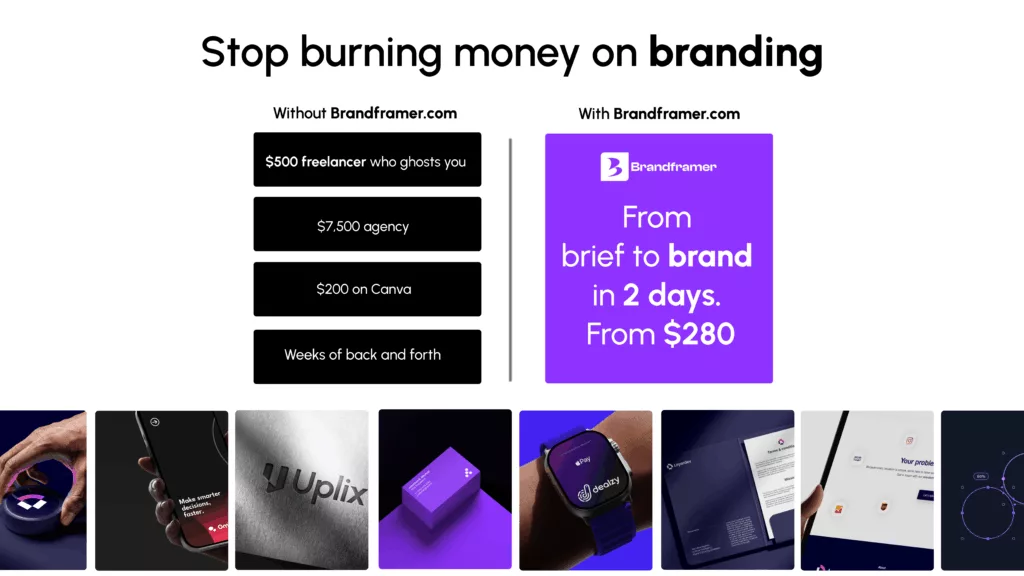
Brandframer runs three fixed tiers, and the price is the price you see, not a starting point for negotiation. Basic sits at $280 for a founder who needs a clean, usable identity fast. Premium runs $480 and expands the system with more brand assets and flexibility. BrandFramer 360, at $987, is built for founders who want the full identity system plus the extras that come up once you’re actually running the brand across channels.
None of the three tiers involve a discovery call. You submit a brief, the team gets to work, and delivery lands within 48 hours. That speed isn’t a gimmick. It’s the direct result of not paying for meetings, project management layers, or a retainer structure that pads out timelines to justify a higher invoice.
Here’s the honest caveat: this model isn’t built for a 40-person company that needs six departments to sign off on a rebrand across an entire product suite. If your project genuinely requires weeks of internal alignment before design can even start, a fixed 48-hour process won’t accommodate that, and a traditional agency retainer might actually be the right fit. For an early-stage founder who needs a professional identity to show up ready before a launch or a raise, it’s close to the opposite problem: too much process, not too little.
For a closer look at what’s actually bundled into each tier, our full breakdown of branding packages for startups covers what changes between them.
Freelancer, subscription service, DIY tool, or fixed-price studio: which is actually affordable?
Each option is affordable on paper. They’re just affordable in different, and sometimes misleading, ways.
A freelancer on Upwork or Fiverr can be genuinely cheap upfront. The risk shows up in consistency and scope. Revisions often get negotiated one at a time, and quality varies wildly from one freelancer to the next since there’s no standardized process behind the work.
Subscription design platforms, the kind that offer unlimited requests for a monthly fee, make sense for teams that need a constant stream of marketing assets. For a single branding project, they’re overkill. You’re paying an ongoing fee for a one-time deliverable, which rarely nets out cheaper once you cancel the subscription after month two.
DIY tools like Canva are the cheapest option in raw dollars. They’re also the least strategic. A template-built logo has no differentiation built in, since thousands of other businesses are pulling from the same library of shapes and fonts.
A fixed-price studio sits in the middle in a way that actually works for most early founders: one clear cost, one delivery window, and a finished system you own outright. No recurring charge, no per-revision haggling, no template collision with a competitor down the street.
How much should a startup actually budget for branding?
For most early-stage founders, a complete brand identity system should cost somewhere between $250 and $1,000, not the five-figure range agency retainers tend to land on. What you get at each price point depends on scope: a basic logo and color palette sits at the lower end, while a full system with guidelines, extended assets, and web-ready files sits closer to the top of that range.
Founders sometimes assume a higher price signals better design. It doesn’t. It usually signals more overhead built into the process, not more value in the output. For a deeper look at how pricing actually breaks down by scope, our guide on logo design pricing walks through what drives cost up or down.
The bottom line on affordable branding services
Affordable branding isn’t a discount category. It’s what happens when a studio removes the parts of the process that exist to justify a bigger invoice, not to make the design better. The work itself, a logo, a color system, typography, guidelines, hasn’t gotten more expensive to produce. What’s expensive is everything agencies wrap around it.
Brandframer built its pricing around that gap. Three fixed tiers, a 48-hour turnaround, and ten years of delivering identity systems across nearly every industry you can name. No discovery calls, no scope creep, no invoice that grows because a meeting ran long.
If you’re comparing options right now, the fastest way to see the difference is to look at what 48 hours and a fixed price actually get you. Check the three Brandframer plans and see which one fits where your brand is today.