Human Design vs AI Branding: Comparison 2026
 Aug 10,2026
Type a prompt into Midjourney or ChatGPT and you’ll have a logo in eleven seconds. It’ll look like a logo, too: symmetrical, on trend, technically clean. That speed is exactly why so many founders start there. But there’s a real gap between generating a logo and building a brand identity that holds up across a pitch deck, a product label, a billboard, and the hundred social posts you haven’t made yet.
The human designers vs AI debate isn’t really about capability anymore. AI design tools are genuinely good at some of this work. They’re bad at the part that actually matters, which is judgment. This article breaks the comparison down service by service, logo design, brand identity systems, packaging, and social creatives, and shows where the line actually sits right now, including why AI outputs in the same category tend to converge on nearly identical results. No hype, no fear-mongering. Just what to use AI for, what to hand to a human, and how not to waste your launch window figuring that out the hard way.
What’s different between AI design and human design?
AI design tools generate options by pattern-matching against millions of existing designs scraped from the internet. A human designer starts from your specific brand, your audience, and what your competitors are already doing, then makes decisions they can actually explain. That’s the core difference, and it shows up everywhere once you know to look for it.
Ask an AI tool for “a modern minimalist logo for a skincare brand” and it’ll give you something clean and plausible. Ask it why the mark should be a specific shape, why that particular shade of sage green will or won’t work on packaging next to five competitors on a Sephora shelf, and it has nothing. It wasn’t trained to answer that question. It was trained to produce an image that looks like the thousands of similar images it learned from.
Human creativity beats AI here for a simple reason: a designer can hold your entire business context in their head while making a single decision. Positioning, price point, the founder’s actual voice, what the brand needs to say in year three when you’ve raised a round and hired a sales team. AI generates in a vacuum. A person designs inside a strategy.
Wondering how long real brand identity work actually takes when someone’s doing the thinking instead of just prompting? Brandframer delivers the full system, logo through guidelines, in 48 hours flat, with a senior designer attached from day one.
Logo design: why AI still produces generic marks?
Run the same bakery logo prompt through an AI tool three times and you’ll get three variations on the same visual cliché: a wheat stalk, a rolling pin, a circular badge in warm brown tones. It’s not wrong, exactly. It’s just what every other bakery founder is generating from the same prompt, which means your “unique” logo is quietly identical to a dozen others in your category.
Here’s why that happens, and it’s worth understanding if you’re going to use these tools at all. An AI model doesn’t choose a design. It calculates the most statistically probable output given your prompt and everything it learned during training. If you ask for a bakery logo, it pulls from every bakery logo it’s seen labeled as “good” or “popular” and converges toward the average of that set: the color most commonly tagged with the word “bakery” (warm brown, cream, terracotta), the shape most associated with the category (wheat, rolling pins, ovens), the layout structure that shows up most often (circular badge, centered wordmark below an icon). It’s not creative. It’s regression to the mean, dressed up to look like a choice. That’s exactly why two founders in the same city, using the same tool, land on nearly identical marks without ever seeing each other’s prompts. They’re both being pulled toward the same statistical center of their category.
A human designer working through a real logo design process starts somewhere AI can’t: competitive audit first, so your mark doesn’t collide with the three other coffee shops in your zip code using the same cup icon, followed by a deliberate decision to move away from category convention where it makes sense, not toward it. Then concept direction, sketch iterations, and a final mark built as clean vector files.
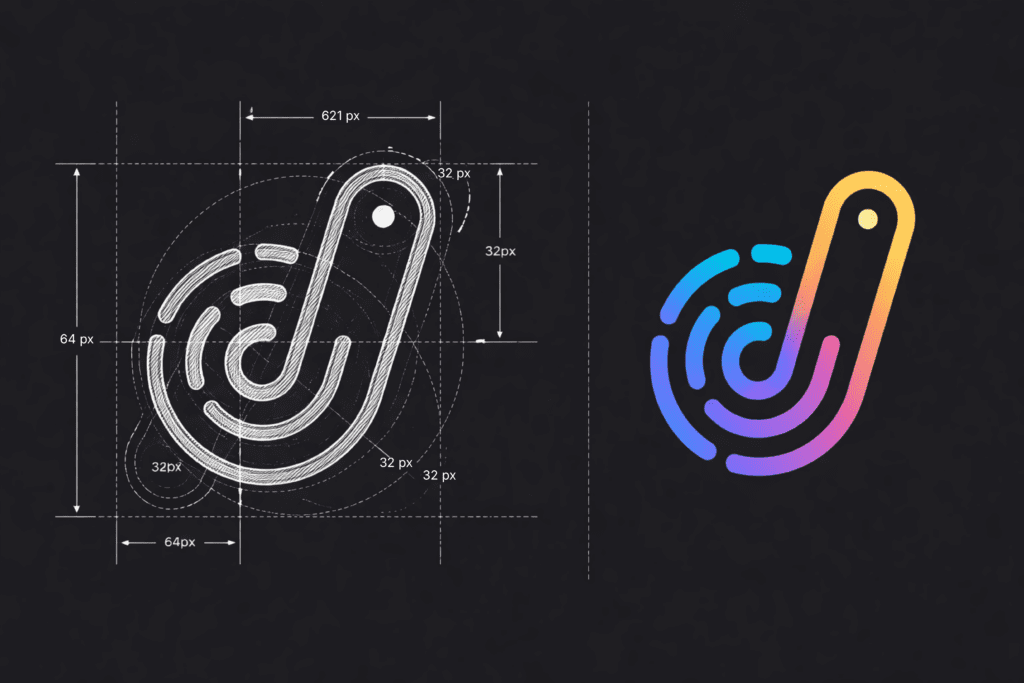
That vector part matters more than it sounds. AI tools output a raster image: a fixed grid of pixels, usually a PNG or JPG. Scale that up for a billboard and it turns blurry. Try to isolate the icon from the wordmark to use them separately on a favicon or a social avatar and there’s nothing to separate, it’s one flattened image. A real logo delivery includes editable vector source files (AI, EPS, SVG), so the mark can be resized to any size without quality loss, recolored for a single-color print application, or split into its component parts. Most founders don’t discover this gap until they’re mid-production with a printer asking for a file format the AI tool never gave them.
This is also where trademark risk shows up. AI tools have no idea whether the mark they just generated is close enough to an existing registered logo to get you a cease and desist letter six months after your launch. A designer with a decade of category experience has usually seen that collision coming before it happens.
Curious what you’re actually paying for when a studio quotes a fixed price instead of a subscription to a prompt tool? Brandframer’s $280 to $987 packages include full vector source files and every format you’ll actually need, not just the flat image you started with.

Brand identity systems: where AI stands as of today?
A logo is one file. A brand identity is a system: typography rules, a color palette with actual hex codes and usage logic, spacing guidelines, and documentation that a print shop, a web developer, and a future hire can all follow without asking you fifty questions. As of today, generating that as a single, coherent, documented system isn’t something mainstream AI tools do in one pass. You’d need dozens of separate generations, each one a fresh probabilistic guess with no shared memory of the last one, and nothing guarantees they’ll feel like they belong to the same brand. That’s a current limitation, not a permanent one. These tools are improving fast, and some are already adding persistent style memory. It’s just not there yet at production reliability.
AI is genuinely useful for early moodboarding, for testing whether a color direction feels right before you commit real budget to it. Used that way, it saves time and it’s a smart first step. The gap shows up when a founder tries to skip the system entirely: a logo that doesn’t match the Instagram templates, which don’t match the deck, which don’t match the packaging, because nothing was ever locked down as a shared source of truth.
Here’s the part that speed alone won’t solve, even as the tools keep improving. Building a system means making calls an algorithm doesn’t have context for: whether a color pairing actually clears accessibility contrast ratios for the platforms it’ll live on, whether a spacing rule holds up at the smallest size someone will realistically see it, whether the whole thing reads as premium or cheap to a specific target buyer. A designer makes that call by reading you, not just your prompt. What a complete brand identity actually requires is a series of judgment calls shaped by a conversation with a founder about what the brand needs to feel like, and that back and forth between two people is where the real system gets built.
Not sure whether your brand needs a full system or just a logo refresh right now? Brandframer’s senior designers scope that with you before any work starts, so you’re not paying for more than the stage you’re actually at.
Packaging: where AI breaks down at scale?
Packaging is where the gap between AI output and production-ready design gets impossible to ignore. Structural packaging needs exact dielines, bleed, and print specs that match your manufacturer’s tolerances, down to the millimeter. Graphic packaging needs to survive being printed at actual size, in actual materials, under actual shelf lighting, not just look good as a 1200-pixel mockup on a screen. AI tools don’t produce print-ready files. They produce images of what packaging could theoretically look like, with no die-cut template, no CMYK color conversion, and no way to check whether your barcode placement clears the fold line.
There’s also a probability problem here too, the same one that flattens logos. Ask an AI tool for skincare packaging and it defaults to whatever’s most represented in its training data for that category: minimalist, white or sage green, sans-serif type, amber glass bottle. That’s not a design decision, it’s the statistical center of every skincare brand already on the market. A human designer working the packaging brief can deliberately position away from that center when the strategy calls for it, which is often exactly when a new brand needs to stand out on a crowded shelf.
Social media and ad creatives: what happens at batch scale in 2026?
Social and ad creatives look like the easiest category for AI to win, and for a single, standalone post, it often does. The gap shows up at volume. A real content calendar needs weeks of assets that all read as the same brand: consistent type treatment, consistent color logic, consistent spacing, resized correctly for Stories, feed posts, in-feed video covers, and banner ad dimensions that don’t crop the logo off the edge.
As of today, generating that batch through mainstream AI tools tends to introduce drift. The color that read as the brand teal in post one shifts slightly warmer by post twelve, because each generation is a new probabilistic pass rather than a pull from a fixed, locked brand file. Over a month of daily posting, that drift is the difference between a recognizable brand and a feed that looks like a few different companies took turns posting. Some tools are actively working on persistent brand memory to close this gap, and it’s likely to get better. It just isn’t reliable at production scale yet.
A human creative team works from an actual template system: locked brand assets, a defined grid, editable source files that get reused and adjusted post to post instead of regenerated from scratch each time. That also makes revisions fast. Ask for a color swap across twenty assets and a designer with the source files changes one variable.
But the bigger point isn’t speed or consistency. Even a tool that nails every hex code perfectly still can’t do the part that actually moves a campaign: reading what a specific audience will respond to, applying contrast and legibility rules so the creative actually works for the platform it’s on, and translating a client’s vague note like “make it feel more premium” into a real design decision. That translation happens between two people. A client describes a feeling to a designer, the designer reads between the lines of what’s actually being asked, and that’s a human conversation, not a prompt. No model, however good it gets at pattern-matching, is having that conversation.
Want to see what thousands of shipped projects looks like versus a few dozen prompts? Brandframer’s studio has run this exact production pipeline, packaging through social creatives, across nearly every industry, which is a different kind of proof than a portfolio of concept renders.
Will AI replace human designers, and which creative roles are actually safe
AI won’t replace designers wholesale. It’s already replacing the part of the job that was commodity work anyway: quick concept generation, rough moodboards, first-pass exploration that used to take a junior designer half a day. That work is disappearing fast, and it should. It was never the valuable part.
What’s not disappearing is judgment: the ability to look at a brand’s actual business goals and make a design decision that serves them, then defend that decision to a founder, a board, or a manufacturing partner. Strategy roles, art direction, and anyone doing production-level execution for print or packaging are getting more responsibility, not less, because someone still has to catch what the tools can’t.
So the honest answer to “which jobs won’t survive AI” isn’t a list of job titles. It’s a line inside every creative role: the parts that were templated and repetitive are going first. The parts that require reading a business and making a call are becoming more valuable, not less, because fewer people are left who can actually do them well.
Ready to stop generating endless options and get your brand framed right the first time? That’s the entire premise Brandframer was built on.
How to decide: when AI tools are enough and when you need a studio
Here’s a practical way to draw the line. Internal exploration, early mood direction, a rough visual for a slide you’re presenting to your own team tomorrow: AI tools are fine, sometimes genuinely faster than briefing a designer for something that low-stakes.
Anything client-facing, investor-facing, or headed to print changes the calculation entirely. A logo you’ll trademark, packaging going to a manufacturer, an identity system a new hire will need to follow without you in the room: that’s where a founder should stop prompting and start briefing. The cost of a wrong AI-generated logo showing up on your Series A deck is a lot higher than the cost of a studio doing it right the first time.
Startups weighing this tradeoff early tend to underestimate how much a mismatched identity costs later, in redesign fees, in investor confusion, in the quiet credibility tax of looking less serious than a competitor with a real system behind them. Branding packages built for startups exist specifically to solve this at the stage where the budget is tight but the stakes are already real.
The actual choice founders are making
Human designers vs AI was never a fair fight to begin with, because they’re not doing the same job. AI generates. Designers decide. A founder who understands that stops wasting time trying to get a prompt tool to do strategic work it was never built for, and starts using both where they actually belong: AI for speed on low-stakes exploration, a human studio for anything that has to hold up in front of a customer, an investor, or a print run that can’t be undone.
Brandframer runs on that split already. Fixed-price packages at $280, $480, and $987, delivered by senior human designers in 48 hours, with no AI in the actual design work. Ten years and thousands of projects across nearly every industry means the judgment call has usually already been made once before, in a category a lot like yours. If you’re past the prompt-and-see-what-happens stage, that’s the next step.