What to Expect From a 48-Hour Logo Design Service?
 Jul 23,2026
Most logo design timelines are padded, not necessary. A traditional branding agency will tell you a logo takes three to six weeks because that’s how long their process has always taken, not because the work itself demands it. Brandframer built its entire delivery model around a different premise: a founder who needs a brand identity this week shouldn’t have to wait a month for one.
A 48-hour logo design service compresses a process that’s traditionally bloated with unnecessary meetings, mood board rounds, and internal approval layers. Done right, it doesn’t cut corners. It cuts waste. This article walks through what actually determines whether a fast logo turnaround works, what slows most agencies down, and how to get a sharp, modern logo without waiting weeks for it.
What should you consider when ordering a 48-hour logo design service?
The main things to check before you order are scope clarity, revision policy, and file delivery. A vague brief is the single biggest reason fast turnarounds fail, so the more specific you are about your industry, your audience, and what you don’t want, the better the first draft will be.
Ask what’s actually included. A “48-hour logo” that only gets you a PNG file isn’t a brand identity, it’s a placeholder. You want vector source files, color codes, font specifications, and ideally a short usage guide so the logo doesn’t get stretched, recolored, or misused the first time someone drops it into a slide deck.
Revisions matter more than people expect. A rushed service with zero revision rounds is a gamble. Brandframer builds in structured feedback rounds within the 48-hour window itself, so speed doesn’t mean you’re stuck with the first concept regardless of fit.
And check who’s actually doing the work, because this is where “fast” starts to mean different things. Some services route your brief through an AI logo generator and call it a design process. There’s no AI involved in a Brandframer logo. Every mark is built by a senior-level human designer who has done this thousands of times across nearly every industry, which is the only way a 48-hour timeline holds up under real scrutiny.
The process itself follows the same logic a slower agency would use, just without the padding. Your brief gets reviewed against your industry and direct competitors first, so the designer isn’t starting from a blank page or a generic template. From there, they develop a small set of concept directions rooted in that research, not five random logo ideas thrown at the wall to see what sticks. You review, give direction, and the designer refines the strongest concept into the final mark, with color and typography decisions made deliberately rather than defaulted to whatever looked fine in a mockup.
If you’re comparing what a real package includes versus a bare-bones one, the brand identity package breakdown covers what a complete deliverable should look like beyond just the logo file.
Ready to skip the guessing and see exactly what you’d get? Brandframer’s three fixed-price tiers spell out deliverables upfront, so there’s no scope surprise on hour 47.
What factors affect turnaround time?
Three things determine whether a logo project ships in 48 hours or drags into week three: brief clarity, feedback speed, and internal process design.
Brief clarity is the biggest lever. A founder who can articulate their audience, their competitive landscape, and two or three brands they admire (and why) gives a designer something to work with immediately. A brief that says “make it look modern” forces the designer to guess, and guessing costs time.
Feedback speed is the second lever, and it’s often on the client’s side. An agency can turn around a revision in an hour, but if the founder doesn’t respond to the first concept for four days, the “48-hour” timeline quietly becomes a two-week one. This is the honest tradeoff worth naming: even the fastest process can’t outrun a slow client, so if you’re ordering a rush service, block time to actually review and respond within the window.
The third factor, and the one most agencies get wrong, is internal process. Traditional agencies build in layers: account manager, creative director, junior designer, senior review, client presentation deck, another round of internal sign-off before you even see a draft. Every layer adds a day, sometimes more.
Brandframer strips that down to what actually produces a good logo: a senior-level designer working directly against a researched brief, with structured checkpoints instead of open-ended meetings that exist mostly to make everyone feel involved. There’s no junior-to-senior handoff, no waiting on a creative director’s calendar, and no AI shortcuts standing in for actual design judgment. It’s the same designer from brief to final file, which is what a decade of doing this thousands of times has taught us actually saves time without cutting the work itself.
Curious how the pricing breaks down against slower agencies charging the same or more? The logo design price guide compares what you’re paying for at different speed and quality tiers.
How to create a modern, eye-catching logo fast?
A logo doesn’t need six weeks to look considered. It needs a clear point of view and a designer who knows how to execute it quickly. Here’s what actually makes that possible.
Start with restraint. The logos that read as dated fastest are the ones trying to do too much: a mascot, a slogan, a gradient, and a tagline all crammed into one mark. A modern logo tends to work in a single color, hold up at 16 pixels in a browser tab, and say one clear thing about the brand rather than five vague ones.
Reference real brands, not trends. Telling a designer “make it minimalist” is less useful than naming two or three logos you actually like and being specific about what works: the restraint, the typography, the way a mark scales. Specificity is what lets a fast process still produce something distinctive instead of generic.
Typography carries more weight than most founders expect. A strong wordmark with well-chosen type can outperform an elaborate symbol, and it’s often faster to execute well because there are fewer moving parts to get wrong. If you’re deciding between a text-based mark and a symbol, the logo design principles guide walks through how to make that call based on your industry and audience.
Color should follow function, not mood board inspiration alone. A fintech brand and a children’s education brand need different color logic entirely, and a designer working fast still needs to know your industry’s visual conventions well enough to break them intentionally, not accidentally.
This is exactly the kind of judgment that separates a fast logo from a rushed one. Brandframer’s designers bring that industry context in from the first draft, backed by the market research done upfront, which is what makes a 48-hour timeline realistic instead of reckless.
What do you get in a 48-hour logo design package?
What’s included depends on the tier, but a complete package should always go beyond a single image file. At minimum, expect your primary logo mark, a set of file formats (vector and raster), a defined color palette with exact codes, and paired typography.
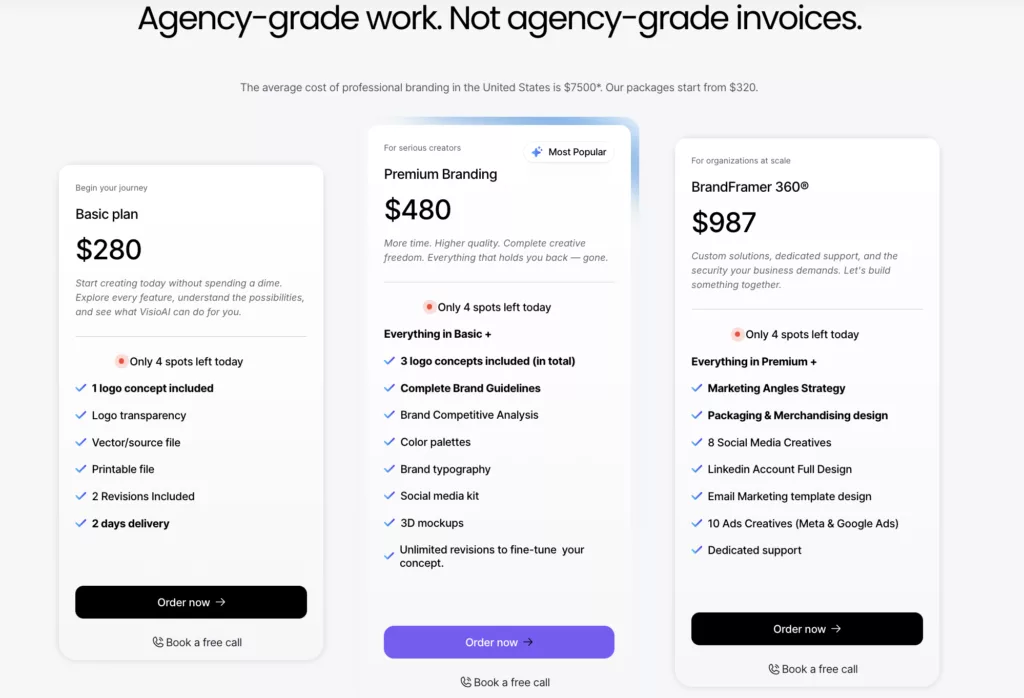
Brandframer’s three tiers scale from there. Basic ($280) covers the core logo and essential files for founders who need something usable fast. Premium ($480) adds a fuller visual identity system, including secondary logo variations and expanded brand assets. BrandFramer 360 ($987) builds out a complete identity system with the depth a founder would typically need before a fundraise or a major launch, delivered in the same 48-hour window as the smaller tiers.
Is a 48-hour logo as good as one that takes weeks?
It can be, but the timeline itself isn’t what determines quality. What determines quality is whether the process still includes real research, real iteration, and a senior designer who understands the brief, and whether that all happens efficiently rather than being skipped to hit the deadline.
Here’s the honest nuance: speed is not the right priority for every founder. If you’re still defining your positioning, your audience, or your product itself, no logo turnaround, fast or slow, will fix a strategy problem. A 48-hour service works best for founders who already know who they’re building for and need the visual identity to catch up to a decision they’ve already made.
For founders in that position, a compressed timeline isn’t a compromise. It’s the removal of dead time that never added value in the first place: the internal meetings, the junior-to-senior handoffs, and the approval chains that padded traditional agency timelines without improving the actual output.
Get your logo without the six-week wait
A 48-hour logo design service only works if the compression comes from cutting waste, not cutting craft. That’s the distinction worth checking before you order from anyone: are they fast because they’ve refined the process, or fast because they’ve skipped steps you’ll notice later, like real research, real concept development, or a real designer behind the file.
Brandframer’s process is built entirely around removing the waste, not the substance. No AI-generated placeholders. No junior designer learning on your project while a senior reviews it after the fact. Just a senior-level designer, working from real market research on your brief, developing concepts the way a slower agency would, minus the meetings that never needed to happen in the first place. That’s what thousands of projects across a decade have shown actually works, and it’s why the 48-hour window is a realistic number rather than a marketing claim.
Whether you need a standalone logo or a full identity system before a raise, the logo design process page shows exactly what’s included at each tier, so you can order today, work directly with an experienced human designer, and have a finished brand identity in your inbox by the day after tomorrow.