Construction logo design: what works and best logos ideas in 2026
 Jun 09,2026
A construction logo might seem straightforward. Hard industry, hard materials, hard lines. You’d think the design would follow naturally. But scroll through any contractor’s website and you’ll notice something: almost every logo looks like it came from the same template pack. A yellow hard hat. A crane silhouette. Bold sans-serif. Done.
That’s not a brand. That’s a category signal, and there’s a difference. A construction logo design that actually works doesn’t just say “we build things.” It says “we’re the company you can trust to build your thing.” This guide breaks down the visual codes that define the sector, what separates generic from memorable, and how to think about your construction company logo before you commission or create one.
What makes construction logo design different from other industries ?
Construction is a trust-heavy industry. Before a client signs a contract worth six or seven figures, they’re making a bet on your reliability, your professionalism, and your ability to deliver under pressure. Your logo is the first visual proof of all three.
That’s why the design constraints are real. You can’t go too abstract, because clients won’t trust what they can’t read. You can’t go too literal either, or you end up with a clip-art crane on a business card. The sweet spot is a logo that communicates stability and competence without looking like every other contractor in the city.
Color plays a big role here. Navy blue, charcoal, and slate greys communicate reliability. Orange and yellow appear constantly because they’re the actual colors of job sites and safety equipment; they carry a kind of industry authenticity. But the moment everyone uses the same palette, the differentiator disappears. Smart construction brands often push into territory that’s just slightly unexpected: a deep forest green, a warm off-white, a precise red that reads more architectural than aggressive.
The visual codes of the construction sector (and when to break them)
There are a handful of recurring motifs in building construction logo design, and they exist for a reason. Understanding them helps you decide which ones to use, subvert, or ignore entirely.
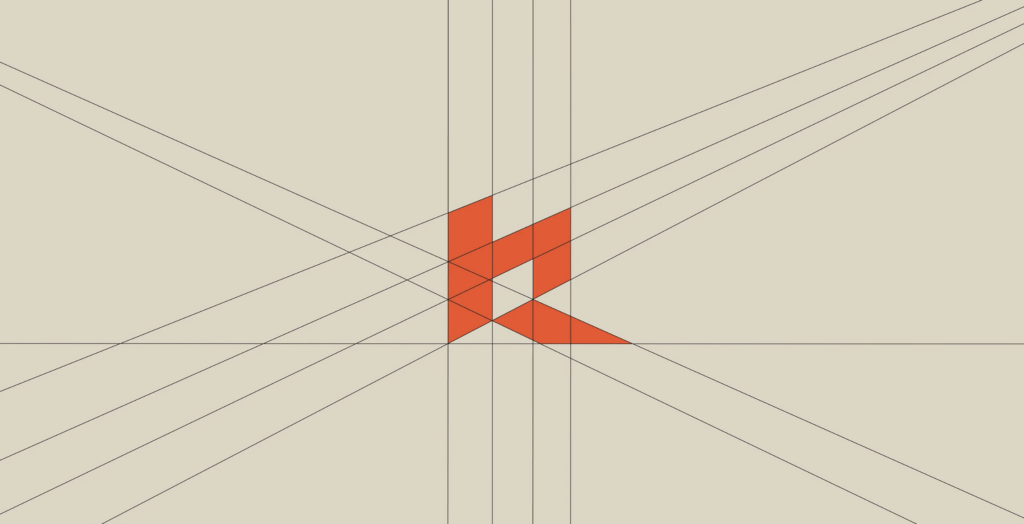
Geometric shapes and structural forms are everywhere: triangles (roof lines, stability), squares and rectangles (foundation, precision), and overlapping planes that suggest architectural drawing. These work because they’re honest to the craft. A triangle in a construction logo doesn’t feel arbitrary; it feels like it belongs there.
Iconography tends to pull from the physical world: cranes, I-beams, hard hats, buildings under construction, abstract representations of a skyline. The risk is always literalness. A crane icon tells people you’re in construction. It doesn’t tell them why you’re better.
Typography does a lot of the heavy lifting in contractor logo design. Wide, geometric sans-serifs with even stroke weights communicate precision and scale. Condensed fonts work well for companies with long names because they allow the wordmark to stay compact without becoming unreadable at small sizes. Serif fonts are rare in construction, but when used well, they signal a firm that’s been around long enough to have history and permanence.
What separates a good construction logo from a forgettable one ?
Here’s the honest version: most construction logos are forgettable not because the designer failed, but because the brief was too vague. “Make it look professional and strong” produces exactly the kind of generic output you’ll see on 80% of contractor websites.
A good construction company logo has at least one decision that’s specific to that company. A family-owned firm with three generations in the business has a different story than a VC-backed proptech startup that builds affordable housing at scale. Those companies should not have the same logo, even if they’re both in construction.
What makes a construction logo distinctive? First, the mark needs to work at every size: from a 16px favicon on a browser tab to a 3-foot vinyl wrap on a fleet vehicle. That constraint eliminates a lot of overly detailed icon concepts early. Then, the color system needs to hold up on site signage, hard hats, and email signatures equally. And finally, there has to be something worth remembering: an unexpected negative space, a letterform that doubles as an architectural element, a color choice that’s confident enough to be owned.
A logo is only one piece of the equation. If you want to understand what sits around it, our guide to brand identity breaks down the full system.
Common mistakes in construction company logo design
The most common mistake is designing for the industry rather than the company. If your logo could belong to any of the 50 contractors in your city, it’s doing the minimum. It fits in, but it doesn’t stand out.
Second most common: treating the logo as a one-time decision rather than the foundation of a system. Your logo will live on a website, a hard hat, a truck door, a PDF proposal, a LinkedIn profile, and a job site banner. A logo that only looks good in one of those contexts is incomplete.
A third issue, specific to construction, is legibility at distance. Job site signage often needs to be read from 30 or 40 meters. A logo with fine details, thin strokes, or low contrast between elements will become a visual blur at that scale. This isn’t just aesthetics; it’s function.
And the honest nuance worth saying out loud: these rules apply to companies competing for clients who evaluate brand as part of their decision. If you’re a small local contractor whose entire pipeline comes from word of mouth and you’ve never lost a job over your logo, spending thousands on a full brand system may not be your highest-ROI move right now. Know where you are.
How to brief a designer on your construction logo ?
Most bad logos come from bad briefs. If you walk into a design process with “something clean and professional,” you’ll get exactly that: something clean, professional, and indistinguishable from everyone else.
A useful brief answers a few specific questions. Who are your clients, and what do they care about most: speed, precision, safety, innovation, or legacy? What’s the one word you want someone to think of when they see your brand? Who are your direct competitors, and what do their logos look like? What do you want to be visually different from?
From there, a good designer can make intentional decisions rather than guessing. The brief is where brand strategy happens. The logo is just where it becomes visible. And when the brief is strong, the design process is faster too, which matters if you’re working against a deadline like a tender submission or a product launch.
Getting your construction logo designed: what to expect ?
Not sure what budget to plan for? Here’s what a logo actually costs, with context on what drives the price up or down.
Template tools work fine for a proof-of-concept or a business that isn’t competing on brand. But if you’re pitching corporate clients, submitting RFPs, or building a construction company that outlasts you, the logo is part of your credibility infrastructure. It needs to be designed, not assembled.
If you need a complete brand identity system, including logo, typography, color palette, and usage guidelines, Brandframer delivers it in 48 hours starting at $280. It’s built for founders and operators who need professional-grade output without a six-week agency process. If your construction brand is on the list, see what’s included.