Starting a business? Here’s the branding checklist for founders
 Jul 20,2026
Starting a small business comes down to a handful of moves: validate the idea, register the entity, open a business bank account, sort out taxes, and get something in front of real customers fast. Most founders can find that checklist in an afternoon. It’s not the hard part.
The hard part is the branding checklist that comes right after, the one that decides whether a business looks like it’s been running for ten years or was assembled last night in Canva. This is where founders lose credibility, waste money, or both, usually without realizing it until they’re sitting across from an investor or a first big client.
This checklist covers what actually belongs in a startup’s brand identity, in what order, and what it should cost. No fluff about “finding your why.” Just the system.
What are the 5 P’s of brand identity?
The 5 P’s of brand identity are purpose, positioning, personality, promise, and presentation. Purpose is why the business exists beyond making money. Positioning is where it sits against competitors in the customer’s mind. Personality is the tone and character that comes through in every touchpoint. Promise is what the brand commits to delivering, consistently. Presentation is the visual system: logo, color, type, and the rules that hold it together.
It’s worth saying upfront that the 5 P’s, like the 3-7-27 rule or the rule of 7 you’ll see floating around branding content, is a working heuristic, not a peer-reviewed framework. It’s useful for organizing thinking, not a formula to follow to the letter.
Most early-stage founders can answer purpose and promise in a sentence. Where they fall apart is presentation, because nobody taught them what a real visual identity system contains versus what a logo generator spits out. That gap is exactly what the rest of this checklist covers, and it overlaps heavily with the difference between a full visual identity and a brand identity as separate but connected assets.
If you want the personality and promise part sorted without burning a week on brand strategy workshops, that’s a conversation worth having before you build anything visual at all.
What branding checklist items do most founders actually skip?
Founders skip the connective tissue, not the obvious pieces. Everyone knows they need a logo. Almost nobody budgets for the system around it.
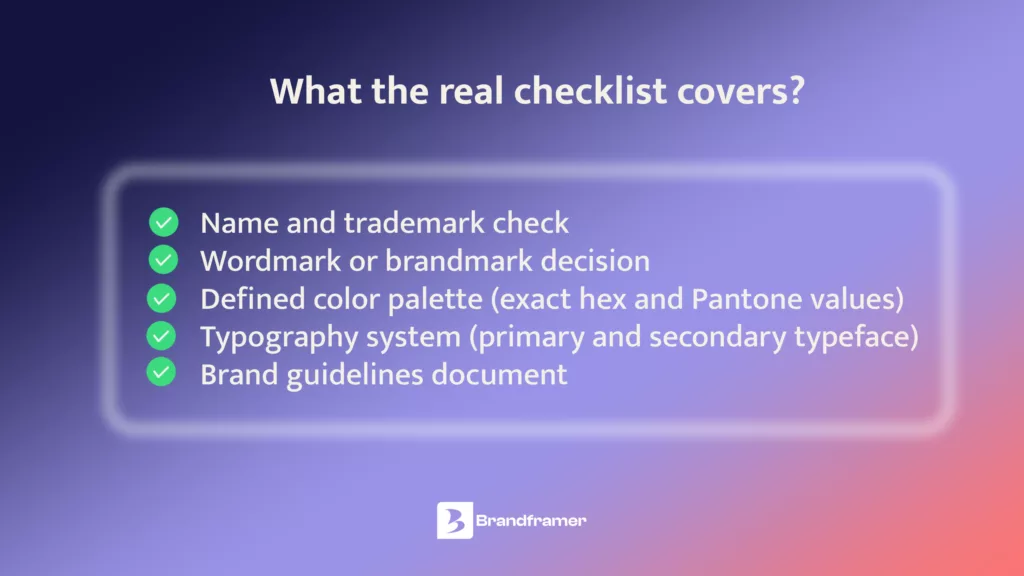
The checklist that actually matters starts with a name and trademark check, because a name that gets challenged six months in costs far more than it would have cost to check upfront. Next comes a wordmark or brandmark decision, and most founders don’t even know these are different things until they’ve already paid for the wrong one.
After that: a defined color palette with exact hex and Pantone values, not “the blue from the homepage.” A typography system with a primary and secondary typeface, licensed properly, not a free Google Font picked at random. And then the piece almost everyone skips entirely, a brand guidelines document that tells a designer, a printer, or a new hire exactly how to use all of it without asking you every time.
A founder who shows up to a sales call with a mismatched deck, three different logo versions floating around the team’s laptops, and no color consistency is already losing the room before saying a word. Buyers read that as risk. And they’re not wrong to.
This is the part of the logo design principles that most generic checklists gloss over: a logo isn’t the deliverable, the system is.
How much should a new business budget for branding?
Realistically, a founder can get a complete brand identity system for well under $1,000, and there’s no reason to spend more at the pre-seed or early-revenue stage. The old model of $10,000+ agency retainers and six-week timelines was built for a different era of branding, before founders needed to move fast and validate quickly.
The $5,000 question that shows up in a lot of startup checklists is really a legal and operations budget question (incorporation, a few months of software, maybe some paid ads testing), and branding is a small slice of that, not the bulk of it.
That’s the whole model behind Brandframer’s three fixed tiers, at $280, $480, and $987, depending on how much of the system you need. No hourly billing, no scope creep, no guessing what the invoice will look like in month three.
When should branding happen, before or after the MVP?
Branding should happen in parallel with the MVP, not after it, and definitely not after the first round of customer feedback comes in. Waiting until “the product is ready” is the single most common sequencing mistake founders make.
Here’s the nuance worth being honest about: if the business model itself is still shifting week to week, full brand investment is premature. Spend that window on a working name and a placeholder mark, and lock in the full identity once the product direction has settled. Branding too early against an unstable business idea just means redoing it later.
But once the core offer is set, even before the product is fully built, the identity should already exist. A founder pitching investors, posting on LinkedIn, or onboarding the first ten customers with a real brand behind them closes more of those conversations than one still using a placeholder logo and an unregistered name.
This is where a defined brand identity package earns its cost fast, because it removes branding as a recurring decision every time new marketing material needs to go out.
What does skipping brand identity actually cost you?
Skipping it doesn’t cost nothing, it just moves the cost downstream and usually multiplies it. A rebrand after eighteen months of inconsistent visuals costs more than doing it right the first time, because now there’s existing brand equity to untangle: old business cards, an outdated website, social profiles with mismatched logos, maybe even a trademark conflict nobody caught early.
There’s also a softer cost that’s harder to put a number on. Every touchpoint without a real identity is a missed opportunity to look like the business the founder is trying to build, not the business they currently are. Investors, hires, and early customers are all pattern-matching on visual signals whether anyone admits it or not.
Is that fair? Not always. But it’s how it works, and building around that reality beats fighting it.
How long should a startup’s branding actually take?
It should take days, not months. Most branding agencies stretch identity work into a six to eight week engagement full of mood boards, revision rounds, and status calls, largely because that’s how they justify the invoice. None of that timeline is actually necessary for a founder who needs to move.
A complete brand identity system, logo, color palette, typography, and a usable guidelines document, can be delivered in 48 hours when the process is built for speed instead of billable hours. That’s not a shortcut on quality. It’s just skipping the parts of the traditional process that exist to pad the timeline rather than improve the output.
For founders also thinking about the site that’ll carry this identity, pairing the brand system with a trusted development partner keeps the visual work and the build moving on the same clock instead of stalling out between handoffs.
The branding checklist, in order
Put together, the sequence looks like this: lock the name and check it’s clear, decide on a wordmark or brandmark direction, define the color and type system, build the guidelines document, and only then start producing marketing material at scale. Skip a step and it usually resurfaces later as a more expensive problem.
None of this requires weeks of workshops or a five-figure retainer. It requires a system built for founders who need to look credible by Friday, not by next quarter. That’s the entire premise behind Brandframer’s three tiers: Basic, Premium, and BrandFramer 360, each one a complete identity system, delivered in 48 hours, with ten years and thousands of projects behind the process. If the checklist above sounds like the version you’ve been putting off, that’s usually the sign it’s time to just get it done.