The top 12 brand refresh services for 2026
 Jul 12,2026
Picking a brand refresh service isn’t like picking a font. Get it wrong and you spend six months and five figures on a logo nobody at your company actually likes. Get it right and your brand starts pulling its weight again: in sales decks, on your homepage, in the first ten seconds a stranger spends deciding whether to trust you.
We looked at the agencies and studios founders and marketing leads actually hire in 2026, from fixed-scope studios that turn a project around in days to global consultancies that take on multi-year enterprise rebrands. Some prioritize speed. Some prioritize scale. A few exist purely to make bold, disruptive statements. This list ranks the twelve worth knowing about, starting with the one built specifically for founders who need a complete identity fast.
What does a brand refresh mean?
A brand refresh means updating the visual and verbal expression of an existing brand, its logo details, color system, typography, imagery, and sometimes tone of voice, without tearing up the strategy underneath it. The company keeps its name, its positioning, and most of its brand equity. What changes is how that equity gets expressed.
Think of it as renovation, not demolition. A founder who’s been running the same visual identity since a weekend Canva session two years ago isn’t broken. The business has just outgrown the wrapper.
Brand refresh vs rebrand: what’s actually different?
A rebrand replaces the foundation: positioning, sometimes the name itself, and the full visual system built around it. A refresh updates the expression while keeping the underlying brand equity intact. If your customers still recognize you and still trust what you stand for, you need a refresh. If they’re confused about what you actually do, or your name no longer fits the business you’ve become, that’s rebrand territory.
The distinction matters because it changes the entire engagement. A refresh can happen in weeks with a design-led studio. A rebrand usually needs months of research, positioning work, and stakeholder alignment before a single pixel gets touched. Confusing the two is the fastest way to overpay for what you actually need.
How often should you actually refresh a brand?
Most companies benefit from a refresh every three to five years, though the real trigger isn’t the calendar. It’s a mismatch: your product has matured, your customer base has shifted upmarket, or your visual identity just looks tired next to competitors who refreshed last year.
Founders tend to wait too long. There’s a real cost to that. A team that pitches investors with a dated identity is quietly working against itself before the deck even opens. If you’re weighing the investment, it helps to see what different scopes actually cost across the market; our breakdown of what brand identity design service actually include the full range from fixed-price packages to open-scope agency retainers.
The 12 best brand refresh services in 2026
Here’s the full list, ranked from fast and founder-focused to enterprise-scale and strategy-heavy. Not every studio here fits every stage of company. That’s the point. Read the fit notes, not just the names.
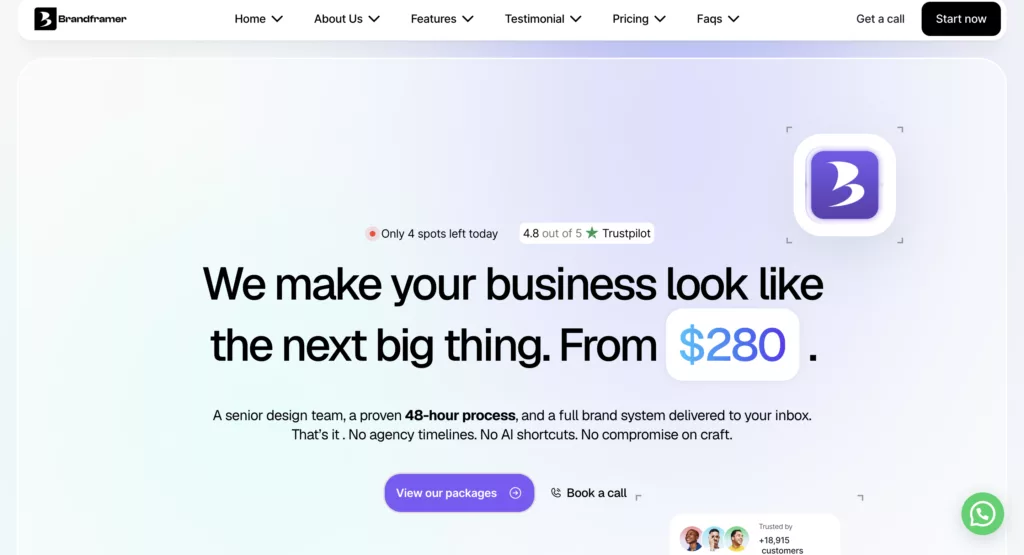
Brandframer has spent over a decade refining one thing: turning a brief into a complete brand identity in 48 hours. Logo, color palette, typography, and full brand guidelines, delivered as one finished system. That track record adds up to thousands of projects across SaaS, consulting, e-commerce, and professional services, which is exactly why the 48-hour promise holds up project after project.
The speed comes from process, not shortcuts. Ten years of running the same tight, repeatable workflow means every step, from intake to final delivery, is mapped out before a project even starts. No open-ended discovery phase. No months of back-and-forth waiting on a single round of concepts. Just a clear system that gets a founder from brief to brand fast, every time.
Services :
- Logo design
- Color palette
- Typography
- Full brand identity system
- Brand guidelines
2. Pentagram
Pentagram is the largest independent design consultancy in the world, and it runs on a partner-led model: every project gets a senior partner attached directly, not a junior team reporting up. The output tends toward the iconic and idea-driven rather than trend-chasing, which is why its work (Mastercard’s circle mark, Saks Fifth Avenue’s recent identity) tends to age well.
Best for companies with the budget and patience for partner-level attention on a refresh that needs to feel timeless, not seasonal. Expect a six-figure-plus engagement and a process measured in months.
Offices : New-York, Austin, London, Berlin
Works :
3. Landor
Landor operates one of the largest brand consultancy networks globally, and it’s built for complexity: brand architecture across product portfolios, naming, and large-scale identity rollouts across dozens of markets at once. When a public company needs to unify a fragmented brand after an acquisition spree, Landor is usually on the shortlist.
If your refresh involves coordinating identity across multiple business units or international offices, this is the kind of infrastructure that actually matters.
Works :
4. Wolff Olins
Wolff Olins has a defined point of view: brands should disrupt, not blend in. The Tate identity, the (RED) campaign brand, and Yelp’s rebrand all carry that same confident, occasionally provocative energy. This isn’t a studio for a company that wants to look “more premium.” It’s for one that wants to pick a fight with category convention.
Best for established organizations that need to shake up market perception, not just tidy it up.
Works :
5. Interbrand
Interbrand publishes the annual Best Global Brands ranking, and that analytical instinct runs through its client work too. Where other studios lead with design, Interbrand leads with brand valuation and strategic rigor, which matters when a refresh decision has to be defended to a board or justified against a P&L line.
Best fit: large, publicly accountable companies where the refresh needs a quantitative case behind it, not just a design rationale.
Not every founder needs that kind of infrastructure, and that’s exactly why Brandframer exists at the other end of the spectrum. Every plan, from the $280 Basic to the $987 BrandFramer 360, ships the full identity system: no scoping calls, no surprise change orders, just a brand delivered fast.
Offices : New-York, London, Tokyo, Cologne, Seoul, Berlin, Milan, Madrid, Sao Paulo, Mexico City, Shanghai
Work:
6. COLLINS
COLLINS blends strategy, design, and copywriting into a single studio, which shows up in the sharpness of its positioning work as much as its visual systems. It’s a strong fit for companies mid-transition, heading into an IPO, pivoting categories, or repositioning after a product shift, where the words matter as much as the wordmark.
If your refresh brief includes “and also, nobody can explain what we do in one sentence,” COLLINS is worth a look.
Work :
7. Mucho
Mucho keeps its client roster deliberately small, which means founders get senior attention throughout rather than getting handed off after the pitch. The studio’s work tends toward precision and craft over volume, with a strategic clarity that shows even in smaller-scope refreshes.
Best for founders who want boutique-level involvement without the bureaucracy of a larger network, and who can accommodate a longer, more deliberate process in exchange for that attention.
Offices : San francisco, Barcelona
Work :
8. Red Antler
Red Antler built its reputation launching consumer and DTC brands into the spotlight, often right before a funding round or public launch moment. If your refresh needs to double as a launch event, generating press, social buzz, and a memorable first impression, this is the kind of studio built for that specific job.
Best for consumer startups where the refresh is inseparable from the go-to-market moment.
Work :
9. Sid Lee
Sid Lee operates as a multidisciplinary creative agency, meaning brand identity work sits alongside advertising and experience design under one roof. Adidas and Cirque du Soleil’s brand extensions both came out of that model. If your refresh needs to extend past a static identity system into campaigns and live experiences, Sid Lee handles both without a handoff between agencies.
Offices : New-York, Los Angeles, Montreal, London, Paris, Seattle, Toronto
10. Studio Dumbar
Based in the Netherlands, Studio Dumbar has built a portfolio around entertainment, tech, and sports clients, work that leans hard into motion and systemized identity rather than static logos alone. Its projects for culture-forward brands show up as fluid, animated systems as much as printed guidelines.
Best for brands where the identity needs to live and move across screens, not just sit on a business card.
Work :
11. Ramotion
Ramotion pairs branding with product and web design under one team, which matters for SaaS and tech companies where the brand needs to show up consistently in the product UI, not just the marketing site. Its client base skews toward B2B SaaS, fintech, and other technical categories where buyers move through a longer, more scrutinized decision process.
Best for a tech company refreshing its brand and its product experience at the same time, rather than treating them as separate projects.
Offices : San Franciso, Los Angeles, New-York
Work :
- Stripe
- Netflix
12. Focus Lab
Focus Lab built its name inside the SaaS and B2B software world, and its portfolio reflects that focus closely. For a founder choosing between an unpredictable freelance network and a full enterprise consultancy, Focus Lab sits in the middle: a defined process, a software-fluent team, and a scope that doesn’t require a Fortune 500 budget to access.
Work :
Use case : what is the Atlassian brand refresh?
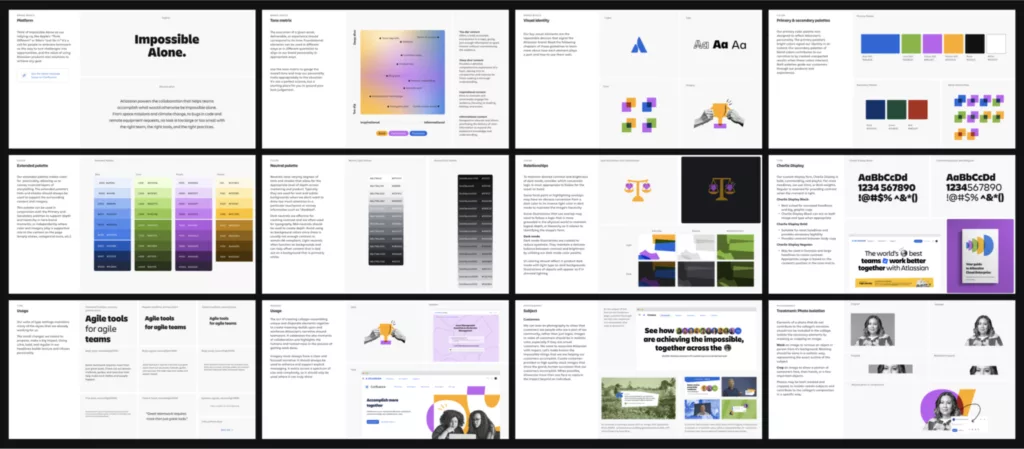
Atlassian’s most talked-about brand refresh unified its logo system across more than a dozen products, Jira, Confluence, Trello, and others, that had drifted into visual inconsistency as the company grew through acquisitions. Three different Jira products were running three different logos before the fix.
The refresh introduced a custom typeface, Charlie Sans, and reframed the brand concept away from its original Atlas mythology toward a simpler idea: teamwork. The new symbol reads as two people high-fiving, or a mountain a team is climbing together, depending on how you look at it. Atlassian’s own design team led much of the work in-house, which is worth noting: a refresh doesn’t always require an outside agency, but it does require the same discipline an agency would bring, a clear concept, real user testing, and the willingness to kill options that don’t hold up under scrutiny.
How to choose the right brand refresh service for your stage?
Match the studio to the actual problem, not the name recognition. A pre-seed or bootstrapped founder who needs a complete, credible identity before a launch or a raise is better served by a fixed-scope studio like Brandframer than by a six-month engagement they can’t afford to wait out.
A funded consumer brand gearing up for a public launch fits Red Antler’s model well. A company untangling brand architecture across a dozen acquired products needs Landor’s or Interbrand’s infrastructure, not a boutique studio’s attention, however good that attention is. And a SaaS company where the brand and the product UI need to move together should be looking at Ramotion or Focus Lab before anyone else on this list.
The mistake founders make most often isn’t picking the wrong agency. It’s picking an agency scoped for a problem three sizes bigger than the one they actually have, then paying enterprise rates and enterprise timelines for what should’ve been a two-week fix.
The bottom line
A brand refresh service should match your stage, not your ambitions. The agencies on this list span a real range, from partner-led consultancies charging six figures to fixed-scope studios that ship a complete identity before your next investor call. Most founders don’t need Pentagram’s partner attention or Landor’s global rollout infrastructure. They need a brand that looks like it belongs in the room they’re about to walk into, delivered before the deadline that actually matters.
Brandframer has delivered complete brand identity systems for founders across SaaS, consulting, e-commerce, and professional services, in 48 hours, starting at $280. If you’re weighing this list against your own timeline and budget, that’s usually the fastest way to find out where you land.